Before kids write letters, they need to control a crayon. They need to hold it comfortably, move it where they want, stop when they mean to and keep going without their hand getting tired. Coloring builds all of that, which is why preschool classrooms are full of crayons long before they are full of worksheets.
The pre-writing skills coloring builds
Grip
A comfortable, controlled grip, usually a tripod grip by age 5 or 6, makes letters easier to form. Coloring with short crayons is a great way to encourage it (see crayon grip tips).
Line control
Letters are made of straight lines, curves, circles and diagonals. Coloring inside shapes and tracing outlines practices every one of them in a context kids enjoy.
Size control
Writing letters that fit on a line means making small, controlled movements. Coloring small spaces such as eyes, spots and buttons builds that precision.
Stamina
A first-grader may write for twenty minutes at a time. Coloring builds the hand endurance to do that without fatigue, a little more each week.
Left-to-right and top-to-bottom habits
When you show a child how to color in tidy rows from left to right, or how to trace a line from the top down, you are quietly teaching the same directional habits handwriting uses.
Tracing: the bridge between coloring and writing
Tracing sits right between coloring and writing. A child follows a path someone else drew, which is exactly what early letter practice asks them to do. Tracing pictures first, rather than letters, keeps it playful and avoids the pressure kids can feel when they "get a letter wrong." We compare them in tracing pictures vs tracing letters.
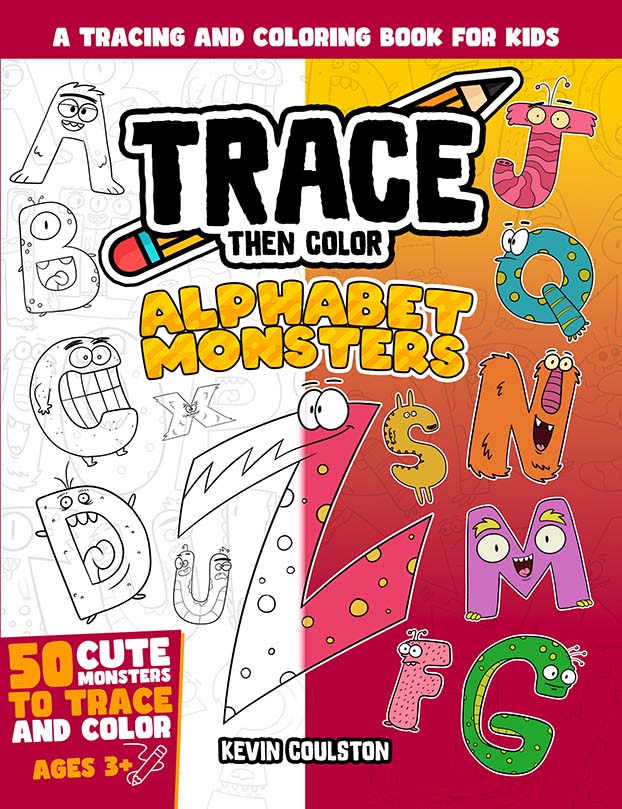
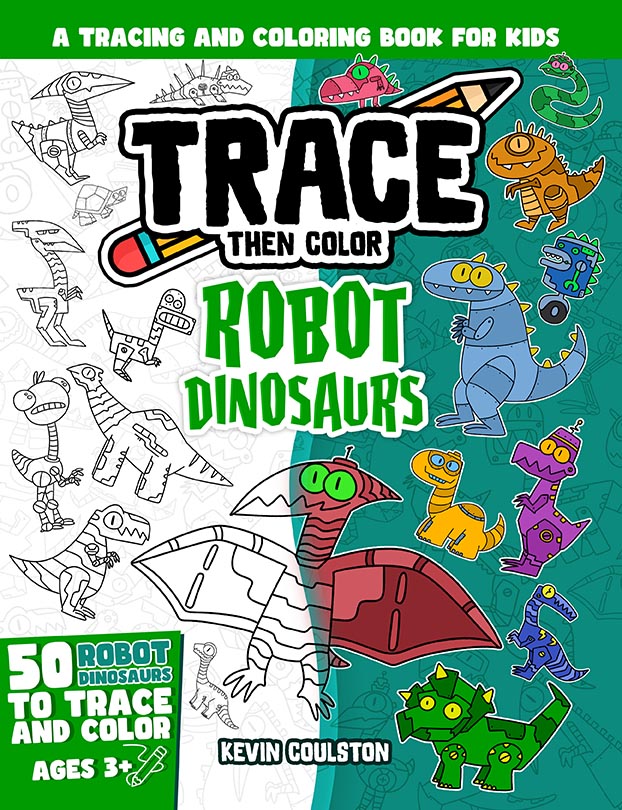
Trace Then Color books give kids a dotted outline of a character to trace, then the fun of coloring it. If you want letter practice in the same format, Trace Then Color: Alphabet Monsters pairs each letter of the alphabet with a monster to trace and color.
A simple at-home plan for 4 and 5-year-olds
You do not need a curriculum. Try this a few times a week:
- Warm up for one minute. Squeeze play dough or play a quick finger game.
- Trace one picture. Follow the dotted outline slowly with a pencil or thin marker.
- Color it. Outline the inside edge, then fill. Talk about colors and shapes.
- Find a letter. Point to a letter that shares a shape with the picture. A round face looks like an O; a robot’s leg looks like an L.
- Stop while it is fun. Ten to fifteen minutes is plenty.
What coloring cannot do on its own
Coloring does not teach which way a "b" faces or how to spell a name. Kids still need direct letter teaching, usually in kindergarten. What coloring does is make that teaching easier, because the child’s hand is ready to follow the instructions.
Signs a child is ready to start letters
- Holds a crayon with the fingertips rather than a fist
- Can copy a circle, a cross and a square
- Colors mostly inside large shapes
- Shows interest in writing their name
If several of these are in place, gentle letter practice is a natural next step. Our kindergarten tracing plan has a four-week schedule.
Questions parents ask
Should my preschooler practice handwriting worksheets?
Short, playful practice is fine if your child enjoys it, but coloring, tracing, drawing and play dough build the underlying skills just as well and feel less like work.
My child colors well but hates writing. Why?
Writing involves remembering letter shapes and order, which is harder than coloring. Keep coloring, add tracing, and keep letter practice short and positive.
Do colored pencils help more than crayons for handwriting?
Colored pencils feel more like a writing pencil, so they are a nice step up once a child has good control with crayons.
About Kevin Coulston
Kevin Coulston is a cartoonist and member of the National Cartoonists Society who has written and illustrated more than 100 drawing, tracing and coloring books for kids, including the Trace Then Color series. Meet Kevin or browse all his books on FirstArtBooks.com.