Spatial awareness is understanding where things are, in relation to yourself and to each other. It helps kids follow directions, build with blocks, read maps, write letters the right way round and, later, solve geometry problems. Research has linked early spatial skills with later math achievement, which is one reason teachers pay attention to them.
Coloring is a great everyday spatial workout because every page is a little map of shapes and spaces.
Spatial ideas inside a coloring page
Inside and outside
The most basic one. A line marks a boundary, and coloring "inside" means understanding that boundary.
Above, below, next to
The hat is above the head. The feet are below the legs. The ear is next to the eye.
Left and right
Faces and bodies have two sides. Coloring the left boot one color and the right boot another is a good way to learn left and right.
Big and small, near and far
Some shapes are bigger than others. Some parts overlap, which shows that one thing is in front of another.
Parts and wholes
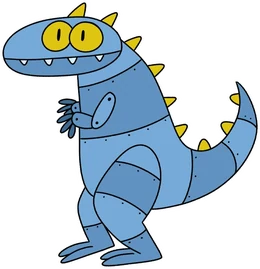
A robot is made of a head, a body, arms and legs, each a separate space. Seeing how parts fit together is a key spatial skill.
Games for spatial awareness
Position word coloring
Give directions using position words: "Color the shape above the robot’s eyes green." "Color everything on the left side of the dinosaur blue." More in color-by-instruction listening games.
Left and right challenge
Put a small sticker on your child’s left hand. Color all the left-side parts one color and the right-side parts another.
Overlap hunt
Find places where one shape is in front of another. Which one is in front? How can you tell?
Build a scene
Cut out colored characters and arrange them on a big sheet: who is in front, who is behind, who is on top of the hill?
Robot parts
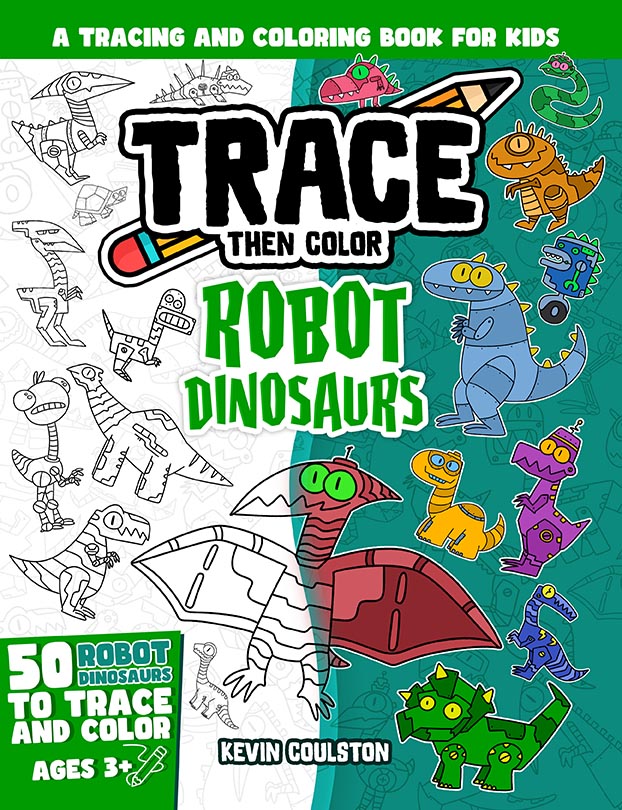
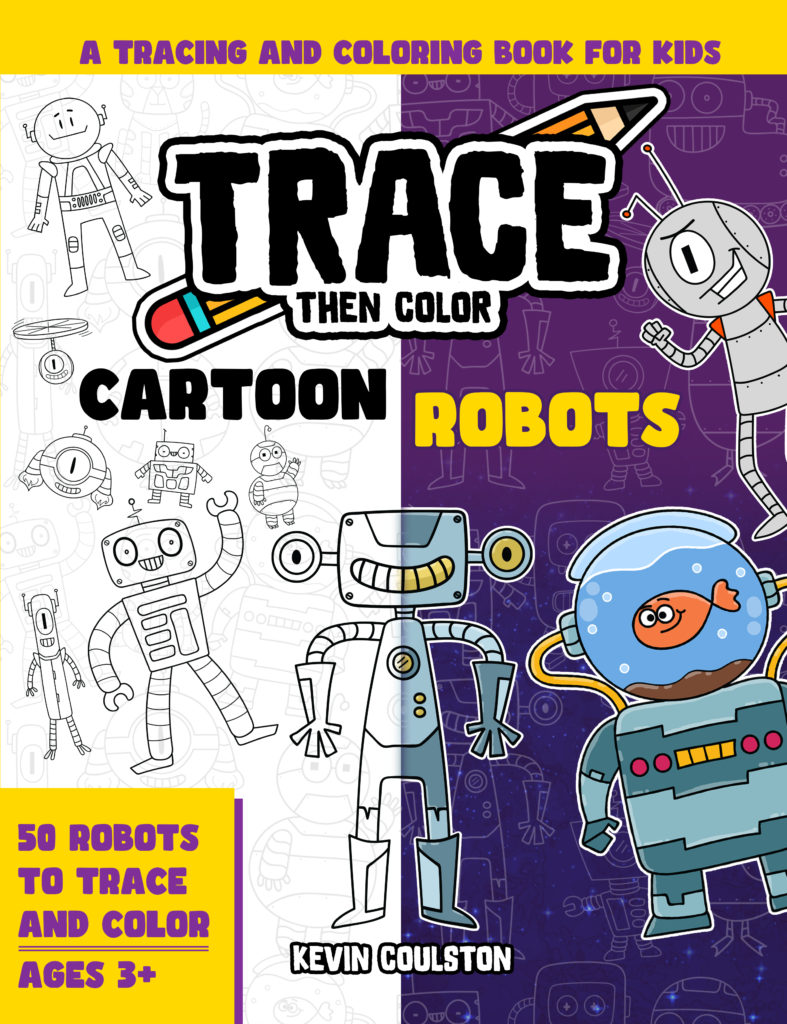
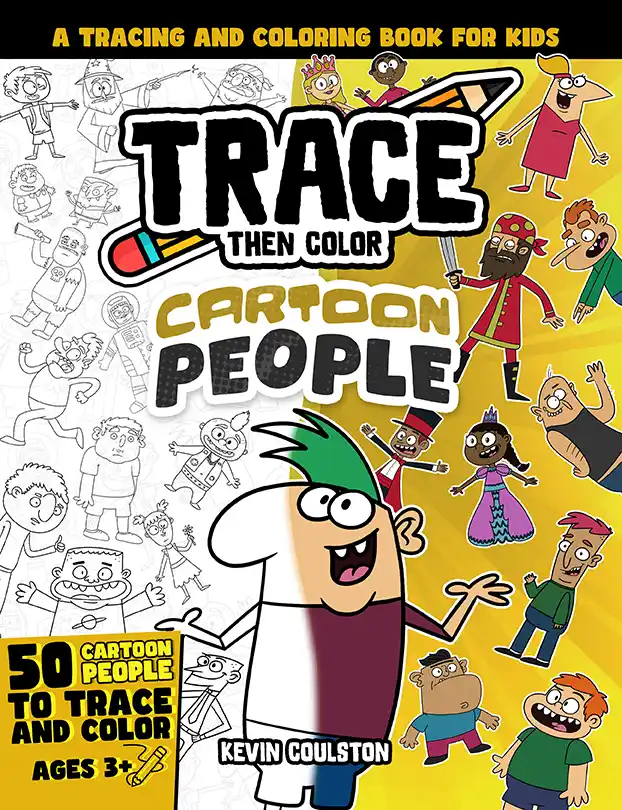
Robots are made of clear, boxy parts, which makes them great for spatial games. Ask kids to color the top part red, the middle part yellow and the bottom part blue. Trace Then Color: Cartoon Robots and Trace Then Color: Robot Dinosaurs both have plenty of distinct parts to name and place.
Tracing adds another layer
Tracing a dotted outline means following a path through space: up, around, down and back. It is a physical way to understand shapes. That is one of the reasons tracing before coloring is so useful for young children (see line types in tracing).
Spatial skills beyond the page
Combine coloring with other spatial play for even more benefit:
- Building with blocks or construction toys
- Puzzles
- Obstacle courses with position words: over, under, through
- Drawing simple maps of a room or garden
Questions parents ask
At what age do kids learn left and right?
Many children start to reliably know left and right around ages 5 to 7. Before that, it is still worth using the words.
Are spatial skills linked to math?
Studies have found connections between early spatial skills and later math performance. Spatial play is a good investment.
My child colors mirror-image or upside down. Is that normal?
Young kids often turn pages around or start from unusual places. It is normal and usually settles as spatial understanding grows.

About Kevin Coulston
Kevin Coulston is a cartoonist and member of the National Cartoonists Society who has written and illustrated more than 100 drawing, tracing and coloring books for kids, including the Trace Then Color series. Meet Kevin or browse all his books on FirstArtBooks.com.